Why Brazil pulled 100+ teeth before the 1958 World Cup
The true story of Mário Trigo, a squad full of infections, and a lesson dental students are still learning.
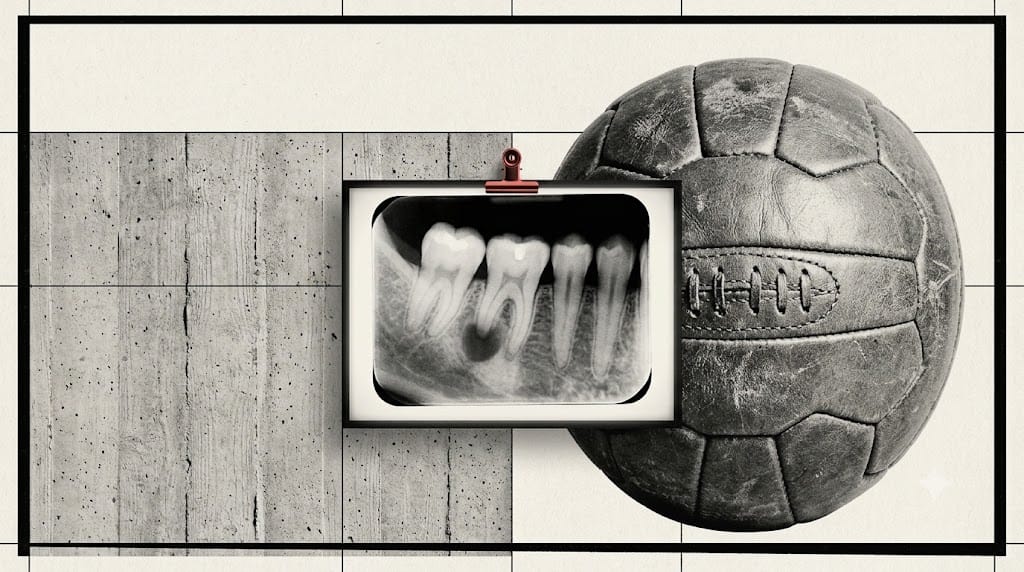
Days before the 1958 World Cup, Brazil's team dentist pulled more than 100 teeth from the squad. The reason matters to every dental and hygiene student: an infected tooth is not a local problem. The inflammation reaches the rest of the body and can slow an athlete's recovery. Mário Trigo saw it in 1958. The research agrees now.
Who was Mário Trigo?
Trigo was the first dentist to travel with Brazil's national team, and he's now called the father of sports dentistry there. Before the 1958 tournament in Sweden, he examined all 33 players in camp. Most had never sat in a dental chair, and their mouths showed it: widespread decay and infection (210 WPFD). He went on to work the winning 1962 and 1970 campaigns. The players kept him around for over a decade.
How many teeth did Brazil actually pull?
Over 100. The exact count depends on the source, running from 118 up to 500-plus, so the accurate way to say it is "more than a hundred, hundreds by some accounts." Either way, a squad about to play for the World Cup carried a heavy load of untreated infection.
Can a tooth infection really affect the whole body?
Yes, and this is the real lesson for your radiology notes. An infected tooth is a live pocket of bacteria with a route to the bloodstream. Researchers describe three of them: bacteria entering the blood, bacterial toxins circulating, and the immune response causing inflammation elsewhere (Clinical Microbiology Reviews). This is the oral-systemic link: the well-evidenced finding that oral infection does not stay in the mouth. The sweeping "focal infection theory" from a century ago overreached and was discredited; the modern version is narrower and backed by data.
Does oral health affect athletes?
This is where Trigo looks ahead of his time. He noticed players with infected teeth recovering slower from muscle injuries. Sports dentistry caught up: poor oral health in elite athletes is linked to systemic inflammation, worse recovery, and higher risk of muscle and joint injury (British Dental Journal, 2025). At the London 2012 Olympics, 18% of athletes said oral health had hurt their performance (study). Elite fitness and a healthy mouth are not the same thing.
What does a tooth infection look like on an X-ray?
Here's the part that goes straight into your clinical eye. When infection at the tip of a root destroys the surrounding bone, it leaves a dark, rounded shadow at the apex called a periapical radiolucency. Healthy bone reads lighter and evenly textured, so that dark halo stands out once you know it. An earlier clue often shows first: the thin dark line around the root, the periodontal ligament space, widens before a full lesion forms. Miss both and the tooth can read as normal while the infection builds. Catching them is the exact skill Papilla drills. Start reading films free.
Why should a dental student care about a 1958 story?
Because the mistake it prevents still happens. It's easy to read the mouth as a sealed compartment: a toothache here, a filling there. Trigo's squad is the memorable counter. Treat the infection and the whole athlete works better; ignore it and the cost surfaces somewhere else, like a hamstring that won't heal. When you read a film, a dark spot at a root tip is not only a tooth finding. It's a whole-body finding you happened to catch first.
The takeaway
Brazil's 1958 win is a good story, but it belongs to dentistry for one reason: an infected tooth is a whole-body problem, and it shows on a film if you know the look. Catch it on the X-ray, and you catch it early.
Frequently asked questions
Did pulling teeth win Brazil the World Cup?
No. Pelé, Garrincha and a strong squad did. But clearing untreated infection removed a real health drag on the players, which is why sports-medicine circles still tell the story.
How many teeth did Trigo pull?
Over 100. Counts vary widely (118 to 500-plus), so "hundreds, by some accounts" is the accurate way to put it.
Is the "mouth infection affects the body" idea real or a myth?
The evidence-based version is real: oral infection is linked to systemic inflammation and to conditions like cardiovascular disease and diabetes. The exaggerated century-old "focal infection theory" that blamed teeth for everything is not.
What is the dark spot at the root of a tooth on an X-ray?
Often a periapical radiolucency: bone loss from infection at the root tip. It's one of the first signs to learn, and a core skill Papilla drills.
You can now picture what a tooth infection looks like on a film. Try it on a real one, free at papilla.io/start.
